


You will not be allowed to compare more than 4 products at a time
View compareWidex Allure Hearing Aid | Natural Sound & Speech Clarity
Widex Allure Hearing Aid | Natural Sound & Speech Clarity
Regular price
$2,299.00
$2,299.00
$2,799.00
-17%

Unit price
per
Shipping calculated at checkout.
Standard Delivery
⏰ Order today within
to get discounted price
🚚 Delivery from
to
Ordered
Shipped
Delivered
↓
Couldn't load pickup availability


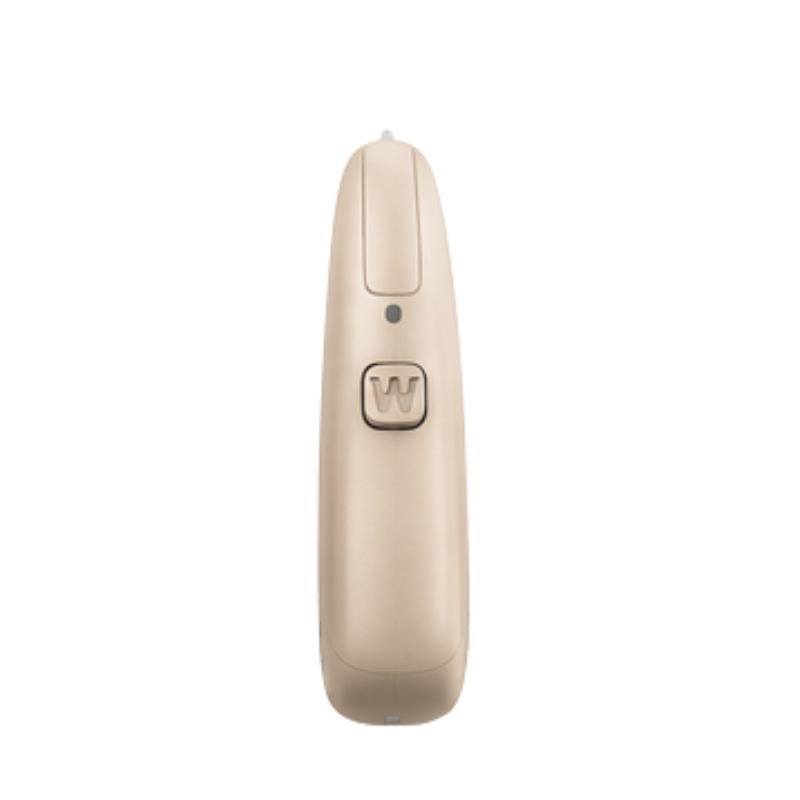
Widex Allure: The Hearing Aid That Sounds the Way the World Actually Does
Widex has pursued one goal longer and more stubbornly than almost any company in hearing care: making hearing aids sound natural. Not processed. Not corrected. Not engineered into clarity but delivered with the kind of transparency that makes the wearer forget there is a device between them and the world. Since 1956, the Danish company has treated natural sound not as a feature but as a foundational commitment, and every platform they have ever built has been evaluated against that standard first.
The Widex Allure is the most capable expression of that commitment yet. Launched in March 2025, it is the successor to the Moment series — a five-year flagship that set the standard for ultra-low-delay sound processing — and it arrives on a completely new processing platform, the W1 chip, that delivers four times the speed and four times the memory of anything that came before it. The result is a hearing aid that processes sound faster, classifies environments more accurately, manages feedback more elegantly, and enhances speech more precisely than any device Widex has made, while retaining the signature sonic character that has made the brand a first choice for people who care deeply about how the world sounds.
If you have ever put on a hearing aid and thought that something was missing — that the sound was clear but not quite real, present but not quite natural — the Widex Allure was built to change that experience.
PureSound 2.0 with ZeroDelay: The Feature That Changes What Hearing Aids Feel Like
The most distinguishing characteristic of any Widex hearing aid is the approach it takes to processing speed, and in the Allure, that approach reaches its most refined expression.
Conventional hearing aids process sound through a digital pathway that introduces a delay between the sound entering the microphone and the sound reaching the ear. That delay, typically measured in the range of six to twelve milliseconds, is small enough that most people never consciously identify it. But the auditory brain is extraordinarily sensitive to the relationship between direct sound arriving naturally through the ear canal and amplified sound arriving through the hearing aid, and when those two signals are misaligned in time, the resulting mismatch creates a quality of sound that, without being specifically identified, makes the world feel slightly artificial, slightly removed, slightly processed.
ZeroDelay technology eliminates that mismatch. The Allure processes sound in under 0.5 milliseconds, a processing time so fast that the auditory system cannot distinguish it from unamplified natural sound. For wearers with open-fit configurations, where natural low-frequency sound enters the ear directly alongside the amplified signal, this matters profoundly. The two signals arrive together. The soundscape is coherent. The world sounds the way it does, not the way a device thinks it should.
PureSound 2.0 is the program that delivers this experience, and it is not a mode the wearer switches into for specific situations. It is the foundation of how the Allure processes sound for wearers with mild to moderate hearing loss in everyday environments. For many first-time wearers and for people returning to hearing care after disappointing experiences with other devices, the transparency of PureSound 2.0 is the moment they realize this is different.
The W1 Chip: Four Times the Power Behind Everything
Every meaningful capability the Allure delivers flows from the W1 chip at its core. Four times faster and four times the memory of its predecessor, the W1 chip enables a level of simultaneous processing that previous Widex platforms could not sustain. Scene classification, feedback management, speech enhancement, and noise control all run at higher resolution and greater precision than before, and they run together, in parallel, without the trade-offs that limited-processing-power platforms must make between one capability and another.
The practical significance of a faster chip is not always visible in a specification list, but it is felt in the wearing experience. The Allure responds to changes in the acoustic environment without the brief hesitation or transition artifact that slower processing can produce. It handles sudden sounds without overcorrection. It manages feedback without the gain-trimming instability that reactive systems introduce. All of this happens because the W1 chip has the headroom to do more things, more accurately, at the same time.
Speech Enhancer Pro: Fifty-Two Bands of Intelligent Clarity
Speech Enhancer Pro is the Allure's primary tool for improving speech clarity in noise, and it operates at a level of spectral resolution that is genuinely new in this generation.
Using 52-band spectral analysis, it works continuously across the frequency range of the incoming sound, identifying the components that constitute speech and gently suppressing the components that constitute noise. The key word is gently. The design philosophy of Speech Enhancer Pro is not to aggressively remove noise and present a stripped-back version of the soundscape to the wearer, but to soften noise enough that speech emerges more clearly while the environmental context remains present and natural.
The result, for wearers in the kinds of listening situations that have always been challenging — restaurants, group conversations, gatherings where ambient noise competes with the voices that matter — is a hearing aid that feels more transparent and less effortful. Not a device that fights the room and wins. A device that makes the room easier to navigate.
Enhanced Sound Classifier: Eleven Environments, Zero Manual Switching
The Allure's Enhanced Sound Classifier continuously monitors the acoustic environment and identifies the listening situation from eleven distinct categories, automatically adjusting processing to match. Moving from a quiet home to a busy street, from a car to a restaurant, from a one-on-one conversation to a group setting: the Allure reads each transition and responds without any input from the wearer.
Eleven environment categories represent a significant increase in classification resolution over previous platforms, and the W1 chip has the processing capacity to run the classifier with the precision and speed needed to make its decisions feel natural rather than mechanical. The transition between programs is smooth. The wearer notices the room changing, not the hearing aid adjusting.
Adaptive Dynamic Feedback Controller: Feedback Eliminated, Not Managed
Feedback has historically been one of the most persistent complaints about hearing aids, and previous solutions — which typically detected feedback after it began and reduced gain to stop it — always introduced a side effect: the reduction in gain meant the wearer temporarily received less sound than they were prescribed, and the cycle of feedback occurrence and correction created a subtle instability in the listening experience.
The Allure's Adaptive Dynamic Feedback Controller takes a different approach. Rather than reacting to feedback after it starts, it continuously models the acoustic pathway and adjusts proactively to prevent feedback from occurring. Independent research confirms that the Allure manages feedback more effectively without compromising sound quality, which means the wearer receives consistent, stable amplification throughout the day without interruption from the corrective processes that reactive systems require.
Twenty-Five Hours of Battery Life and Effortless Recharging
The Allure runs on a rechargeable lithium-ion cell delivering up to 25 hours of daily use, including approximately seven hours of streaming. A full overnight charge is complete in four hours. For days that run longer than expected, 30 minutes on the charger adds four hours of use.
The charging setup is straightforward: dock both devices in the desktop charger, confirm charging status via the front-mounted LED indicators, and pick them up ready to go in the morning. A portable charger, introduced later in 2025, makes the Allure fully mobile, supporting extended travel or active lifestyles where a wall outlet is not always available.
Bluetooth LE Audio and Auracast-Ready Architecture
The Allure connects via Bluetooth LE Audio, the modern wireless standard designed from the ground up for audio quality, lower power consumption, and broadcast capability. For the wearer, this means direct streaming from iPhone and compatible devices, with audio quality and connection reliability that earlier Bluetooth standards could not consistently deliver.
The Allure's hardware is Auracast-ready, meaning it is built to receive public audio broadcasts from venues, public spaces, and institutions as Auracast transmitter adoption expands. In airports, lecture halls, places of worship, and anywhere Auracast infrastructure is installed, the wearer receives the venue's audio feed directly in their hearing aids with no additional equipment or effort required. The device is prepared for that world now.
Widex App: AI-Powered Personalization in Your Pocket
The Widex app gives Allure wearers a level of personal sound control that goes beyond basic volume and program adjustment. The AI Quick Assistant offers instant sound recommendations based on what other wearers in similar acoustic environments have preferred, providing a starting point for adjustment that is grounded in real-world data. The AI Sound Assistant enables the wearer to create and save personalized sound profiles for specific recurring situations in a few taps.
My Sound Control allows manual adjustment of bass, midrange, and treble across listening environments. Volume can be managed independently for each ear. Directionality can be adjusted in real time. For wearers who enjoy being actively involved in shaping their own hearing experience, the depth of control the Widex app provides is genuinely satisfying.
Apple Watch control lets iPhone users adjust volume, change programs, and check battery status from their wrist. A Find My Hearing Aids feature helps locate misplaced devices. An online hearing test is accessible directly from the app for those still at the beginning of their hearing journey.
A Growing Family for Every Wearing Preference
The Allure platform continues to expand. The flagship Allure RIC RD — a rechargeable receiver-in-canal device available in three technology levels — anchors the range. A BTE model supports mild to profound hearing loss with telecoil, broader amplification range, and extended battery life. An ITE model, including Widex's first-ever rechargeable custom in-the-ear option, brings the Allure platform to wearers who prefer a device that sits within the ear.
Across all form factors, the W1 chip, PureSound 2.0, Speech Enhancer Pro, and the Allure's commitment to natural sound remain consistent. The platform adapts to the wearing preference. The experience does not change.
Who the Widex Allure Is For
The Widex Allure was built for people who want to hear the world, not a processed version of it. People who have tried other hearing aids and found them clear but not natural, helpful but not transparent. People with mild to moderate hearing loss who are at the beginning of their hearing journey and want to start with a device that sounds right from the first day. People who have been wearing hearing aids for years and are ready for a platform that has genuinely advanced beyond what came before.
It suits mild to severe hearing loss across its available models, and at every technology level, the signature Widex commitment to natural, transparent sound is present and central.
Ask your hearing care professional to demonstrate the Allure. Pay particular attention to how the world sounds the moment you put it on. Because that first impression — of sound that is clear but also, unmistakably, real — is the experience the Widex Allure was designed to deliver.
About your query!
Still Confused? Find Your Answers Here-
Which hearing aid brand is best: Phonak or Starkey?
Both Phonak and Starkey offer premium sound quality and smart features. Phonak is known for natural hearing performance, while Starkey focuses more on AI-powered speech clarity and health features.
Are modern hearing aids Bluetooth compatible?
Yes, most modern hearing aids support Bluetooth connectivity for streaming calls, TV audio, and music directly from smartphones and other devices.
Which hearing aids are better for speech clarity in noise?
Both brands perform well in noisy environments. Phonak offers adaptive sound balancing, while Starkey provides AI-based speech enhancement.
Are rechargeable hearing aids worth buying?
Rechargeable hearing aids are convenient for daily use as they eliminate the need for frequent battery changes and provide all-day performance.
Can I buy hearing aids online?
Yes, you can compare models, features, and prices online before choosing the right hearing aid for your hearing needs and budget.
Where can I get expert guidance for hearing aids?
You can visit Ear Solutions for expert hearing tests, hearing aid trials, and personalised recommendations.